headsetBY REDGOLDExplore the system ↗

MODULAR AUDIO, THOUGHTFULLY WORN

More music.
Less in the way.

Independent support. Deliberate acoustics. Two approaches to a high-quality audio wearable that can work alongside your glasses.

Engineering concept. Fit, acoustic response, transparency, noise cancellation and complete-system performance remain unmeasured.

SPATIAL DESIGN STUDYDRAG TO ROTATE
Small-earpiece and large-cup exploded studies. Internal modules and support roles follow the design; neither shell has final CAD. Choose a variant below to change the assembly.Small-earpiece and large-cup exploded studies. Internal modules and support roles follow the design; neither shell has final CAD. Choose a variant below to change the assembly.
Small-earpiece and large-cup exploded studies. Internal modules and support roles follow the design; neither shell has final CAD. Choose a variant below to change the assembly.
2distinct proposed variants
small earpiece & large cup
6 + 1environmental + voice mics
in the collar reference architecture
1independent support system
keeps audio loads off the glasses

Choose the fit.
Understand the tradeoff.Design intentions and planning values.
Not complete-system ratings.

THOUGHT IN EVERY INTERFACE

Designed around the ear.
Independent of the glasses.

Audio has its own support, power and acoustic needs. It should work with the optical system without pulling it out of alignment.

A lightweight titanium-hook concept supports the small canal-entrance earpiece. The larger electrostatic option adds a soft perimeter seal and a second reaction point. Body-worn compute and power support synchronized microphones and independently tunable output paths.

THE ARCHITECTURE, OPENED UP

Every sound
has a path.

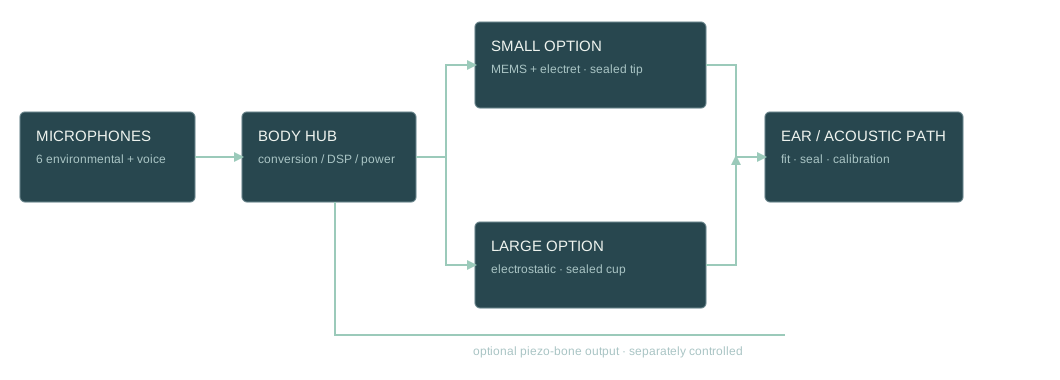
The sensing and processing architecture is shared; the two driver packages have different fit, drive and support requirements.

headset functional architectureFunctional signal flow, not a validated ANC loop or acoustic response. MEMS + electret is the small option; the large cup uses a full-range electrostatic panel. Bone output is optional and separate. Sealed fits use microphone-mediated outside hearing.MICROPHONES6 environmental + voiceBODY HUBconversion / DSP / powerSMALL OPTIONMEMS + electret · sealed tipLARGE OPTIONelectrostatic · sealed cupEAR / ACOUSTIC PATHfit · seal · calibrationoptional piezo-bone output · separately controlled

Functional signal flow, not a validated ANC loop or acoustic response. MEMS + electret is the small option; the large cup uses a full-range electrostatic panel. Bone output is optional and separate. Sealed fits use microphone-mediated outside hearing.

Let the optics keep their alignment.

The headset uses its own titanium-wire support. The small tip provides its own acoustic seal; a larger cup needs an additional nape, occipital or skull reaction point.

The lightweight ear hook alone is not assumed comfortable for clamping a 30–60 g-per-side cup.

MADE CONCRETE

Look closer.
The details matter.

Reference dimensions and proposed interfaces make the concept tangible. Full packaging remains part of the design work.

Small · MEMS + electret

A shallow concha/canal-entrance shell with replaceable silicone tip, supported by a titanium ear hook. Montara Plus is the proposed main path; Sonion EST handles the upper band. Bass capability in this fit and bare-part availability still need confirmation. The shown fallback cavity is optional.

Change the assembly in the viewer ↑
SMALL DRIVER REFERENCE

5.15 × 10.8 × 1.15 mm

Montara Plus top-firing driver envelope from the source note. A final shell must also accommodate the electret, transformer, wiring, tip and strain relief.

SMALL PACKAGING TARGET

8–10 mm shell width

Under 3 g per earpiece is a target, not a weighed result. Driver length sets the shell’s long axis; shallow fit and bass need joint evaluation.

LARGE SUPPORT EXAMPLE

About 1 N / side

An approximate seal-force discussion with a very soft gasket. The 30–60 g-per-side cup allowance exceeds the light-pod hook assumption, so a second reaction point is proposed.

OPEN ABOUT WHAT GOES INTO IT

Know which build
the number belongs to.

USD component references, historical source snapshots and clearly visible gaps.

Montara Plus test coupon$199 each
Retrieved listing · Oct 12, 2026

One is enough for a mono coupler experiment; stereo evaluation needs two. The source snapshot found conflicting stock signals and no bare-driver listing.

Component source ↗
Aptos2 evaluation drive board$299
Retrieved listing · Oct 12, 2026

A reference evaluation platform for MEMS drive. It is not the final wearable drive PCB or a completed stereo/multiway channel budget.

Component source ↗
Sonion EST65DA01 pair$151.24
Retrieved proxy listing · Oct 12, 2026

Two × $75.62, with transformers in the historical listing. Availability and exact supplied configuration need fresh confirmation.

Component source ↗
Knowles BA bass-fallback pair$44.88
Retrieved distributor listing · Oct 12, 2026

Two × $22.44. Optional below the MEMS path if shallow-fit bass falls short; it is a magnetic driver.

Component source ↗
Small reference setup bundle$1,150–$1,350
Historical mixed-evidence estimate

Includes overlapping drivers/drive, playback/fit parts, selected measurement tools and optional fabrication materials. Not additive to rows above; not a retail wearable quote.

Large electrostatic cup & energizerUnpriced
Element and drive selection open

Donor or custom electrostatic panels, shallow cup/gasket, support, insulation, drive and calibration. No final element or compatible complete BOM is selected.

Microphones, body hub & final mechanicsUnpriced
Final integration scope open

Environmental/voice array, synchronized conversion, multiway outputs, body power, shells, supports and serviceable cable routing are not covered by a completed premium-system price.

Download component references ↓

THE QUESTIONS WORTH ASKING

Behind
the concept.

Are these physically open-ear?

The current small design seals at the canal entrance, and the large electrostatic design encloses the front volume with a gasket. Outside hearing is then microphone-mediated transparency. A vent or open-ear alternative changes bass and isolation and requires its own acoustic profile.

Why two variants?

The small MEMS/electret design prioritizes a shallow compact shell. The larger electrostatic cup gives a full-range diaphragm a sealed front volume, with different support, insulation and drive needs. They answer different fit questions; one price or performance figure cannot describe both.

Is “magnet-free” a health claim?

No. The proposed MEMS-plus-electret main path has no permanent magnet, but still has electrical drive and an electret transformer with an AC field. Adding the BA bass fallback introduces a small magnet. Actual fields require measurement; no general health benefit or absolute lowest-field performance is established.

Does it already have ANC and natural transparency?

Those remain system goals. Their quality depends on seals, microphones, synchronization, processing, acoustic tuning and delay. The existing electrical and microphone designs are useful references, but no assembled ANC, latency, frequency-response or long-wear result is recorded for these premium variants.

THOUGHTFULLY DESIGNED. OPENLY EXPLAINED.

Your glasses. Your music.
Room for both.

Explore the assembly ↑